
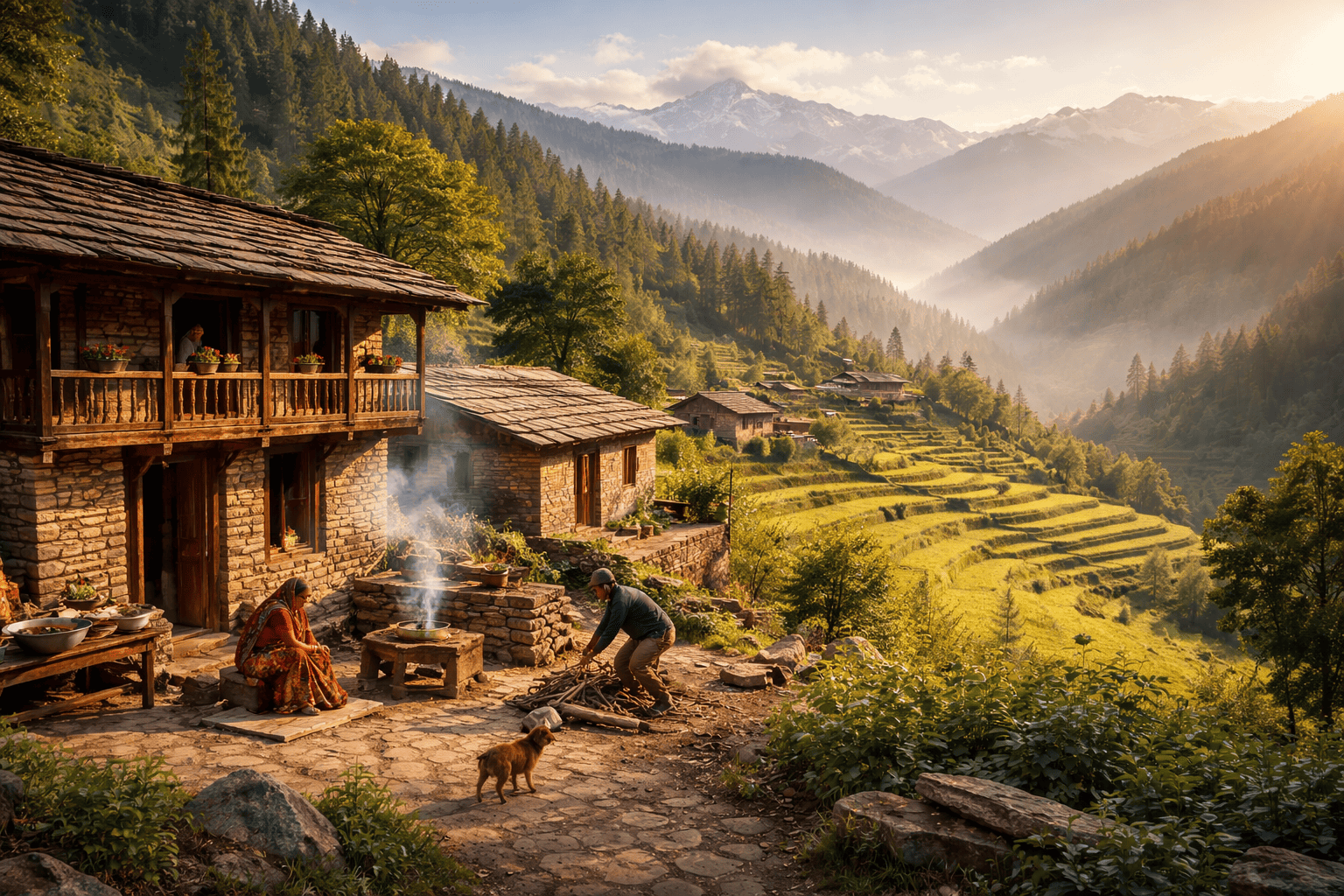

Most people searching for a place to stay in the Uttarakhand hills end up with two types of results: a hill station hotel with a lobby and a fixed checkout time, or a resort somewhere near the highway that puts “mountain view” in the name but faces a parking lot.
A Pahadi homestay is neither.
It takes a little longer to explain — which is probably why most booking platforms don’t bother. But if you’ve ever felt like a hotel gave you a room and nothing else, the Pahadi homestay concept might be the most useful thing you read before your next trip to the hills.
What Does “Pahadi” Actually Mean?
Pahadi (पहाड़ी) means “of the mountains” or “from the hills” in Hindi. It’s the word the people of Uttarakhand and Himachal Pradesh use to describe themselves, their food, their language dialect, and their way of life.
When you say Pahadi homestay, you mean a home in the hills run by a mountain family — not a commercial establishment that borrowed the word for marketing.
The distinction matters more than it sounds. There are plenty of properties in Mussoorie and Nainital that call themselves “homestays” while operating more like small hotels with no host present, caretaker-managed rooms, and an OTP for the door lock. That’s fine, but it’s not what Pahadi homestay means.
A real Pahadi homestay is a family’s actual home. The host lives there. Their kitchen is the one making your dal. The dogs by the gate are their dogs.
The Basic Structure: What You’re Booking
When you book a Pahadi homestay, you’re renting one or two rooms inside (or attached to) a working family home in a Garhwali or Kumaoni village.
The setup varies — some hosts have purpose-built guest rooms on the ground floor while the family lives above, others have converted an old storeroom or a separate chaupal structure. But the common thread is that the host is on-site, the meals come from one kitchen, and there’s no other guest at the property you don’t know about.
Most Pahadi homestays in Uttarakhand offer:
- 1 to 4 guest rooms (rarely more)
- Attached or shared bathroom with running hot water (geyser or bukhari-heated in winter)
- Home-cooked meals — breakfast and dinner as standard, sometimes all three
- A terrace, balcony, or open sitting area
- Host contact via WhatsApp for everything from arrival time to food preferences
What they don’t offer: room service, a reception desk, housekeeping that comes at 9am sharp, or a printed menu. If any of those things matter to you, a hotel is a more honest choice and there’s nothing wrong with that.
How a Pahadi Homestay Is Different from a Hotel
The difference starts before you arrive.
When you book a hotel in Rishikesh or Dehradun, you’re booking a room in a building managed by staff. The person who checks you in might change every shift. The food comes from a commercial kitchen serving 40 guests. The experience is consistent because it’s designed to be consistent.
When you book a Pahadi homestay in Tehri Garhwal or Pauri, you’re entering into something more like a personal arrangement. The host knows you’re coming. They’ve made a rough plan for what to cook. The room is ready because they prepared it themselves.
That difference plays out in specific, practical ways:
The food is not the same food.
Hotel breakfast in the hills is usually bread toast, omelette, and a bowl of cornflakes that’s been in the packet since last season. Pahadi homestay breakfast is mandua roti with ghee, aloo sabzi, and whatever seasonal local thing the host has. In Tehri Garhwal, that might mean kafali (leafy greens cooked in curd) or jhangora porridge. You won’t find either item on a hotel menu. You won’t find them on a restaurant menu in Delhi either.
The information is better.
Hotel staff at a hill property often know the same two or three tourist spots that are in every travel blog. The Pahadi host knows the village. They know which trail the leopard uses in October. They know the shortcut to the temple that takes 20 minutes off the route. They know which local family has the best homemade pahari achar and will arrange a small jar for you. That kind of local knowledge is not available for purchase at any price point.
The quiet is different.
Hotels in hill stations — even the “boutique” ones — have ambient noise. Other guests in corridors, staff conversations, the generator, the geyser pump cycling on and off. Pahadi homestays are quiet in the way that villages are quiet. Birdsong at 5am. Wood being chopped somewhere down the slope. The kind of silence that feels unfamiliar the first night and necessary by the third.
The money goes somewhere real.
At a hotel, your money pays for the building, the staff salaries, the supply chain, and the profit of whoever owns the property management company. At a Pahadi homestay, the host gets paid directly. In many Uttarakhand villages, where the main economic alternative is seasonal farm income or migration to Haridwar or Delhi for construction work, a guest staying three nights and paying ₹1,500 per night is a meaningful income. Not charity — honest commerce.
How a Pahadi Homestay Is Different from a Resort
Resorts need a section of their own because they’ve done the most work to blur the line.
A resort in the Uttarakhand hills will often use the words “authentic,” “local,” and “immersive” in their description. They’ll have a bonfire night. They’ll serve one Pahadi meal during the stay, usually described as a “culinary experience.” They’ll have a wooden interior and pictures of local women in traditional dress in the lobby.
None of that is the same as staying in a Pahadi home.
Here’s the structural difference: a resort is a hospitality business that has absorbed some Pahadi aesthetics as a selling point. A Pahadi homestay is a Pahadi family that has opened their home to outsiders. The direction of the relationship is reversed.
At a resort, you are a customer. The staff is trained to treat you as one. Your feedback goes into a Google Review, not a conversation.
At a Pahadi homestay, you are a guest in the older sense of the word — someone a household has taken responsibility for. The host will tell you if the road to the viewpoint is bad after the last rain. They’ll knock on your door if breakfast is getting cold. They’ll sit with you in the evening if you want to talk, and leave you alone if you don’t.
That dynamic — harder to manufacture than wooden interiors — is what people who’ve stayed at a real Pahadi homestay keep trying to describe when they come back.
The Culture You Actually Connect With
This is where the “authentic experience” phrase gets thrown around so much it starts meaning nothing. So let’s be specific about what culture actually means in the context of a Garhwali or Kumaoni village stay.
Language. Your host will likely speak Hindi and some English, but their first language is Garhwali or Kumaoni. You’ll hear it in conversations with neighbours, in the kitchen, on phone calls. If you spend three or four days, you’ll start picking up a few words. *Aaba* means come. *Ransu* means evening. *Kafal* is a local wild fruit that the whole village waits for in spring. Knowing what kafal is — because your host explained it while picking it off a branch on the walk — is a different kind of travel than reading about it later.
Daily rhythm. Village life in the Uttarakhand hills moves on a schedule tied to sun, season, and agriculture. Hosts wake early. The kitchen is active from 6am. Animals, if the family keeps them, get fed before guests get breakfast. In winter, the woodburning bukhari in the common room becomes the centre of the house by 7pm. These rhythms aren’t a “cultural experience package” — they’re just how the house works. Being present inside them for a few days changes how you think about your own schedule.
Food as information. Pahadi food is not just different in taste — it’s different in logic. The grains grown at high altitude (mandua, jhangora, ogal) are used because they grow here, not because they’re trendy. The local spices (jakhiya, timur) are used because they suit the climate and cooking method. The seasonal vegetables change week by week depending on what the kitchen garden has. Eating that food — especially when the host explains where the jhangora came from or why they don’t use much chilli — is a compressed lesson in how a mountain economy actually works.
Festivals and timing. If your stay overlaps with a local festival — Harela in July, Ghee Sankranti in August, Nanda Devi Raj Jat if you’re very lucky — a Pahadi homestay host will include you in whatever way feels natural. That might mean being invited to watch a puja at the village temple, being offered a piece of something sweet that was made that morning, or simply being told what the occasion is and why it matters. You won’t get this at a resort.
—
The Peace That Hotels Can’t Manufacture
There are things a hotel can offer that a Pahadi homestay cannot — consistency, anonymity, a guarantee that checkout will go smoothly regardless of whether anyone in the household is having a difficult day.
But there is one thing a Pahadi homestay offers that no hotel budget can replicate: genuine stillness.
The hills of Uttarakhand — Tehri Garhwal, Pauri, Chamoli, the ridges above the Rishikesh-Devprayag highway — are not quiet because they’ve been designed to be quiet. They’re quiet because they’re far from roads, and the people who live there have organised their lives around that distance. The result is an absence of background noise that most urban travellers haven’t experienced since childhood, if ever.
Waking up at a Pahadi homestay in November, when it’s cold enough to see your breath inside the room and the sun comes over the eastern ridge at 7am, is not a “peaceful retreat experience.” It is just quiet. Actually quiet. The kind that takes a day to stop feeling strange.
That quiet — and the slower thinking that comes with it — is what most people are actually searching for when they book a “Himalayan escape.” Hotels and resorts try to simulate it. A Pahadi village already has it.
Benefits of Staying at a Pahadi Homestay: The Practical List
For people who prefer specifics over atmosphere:
Cost. Pahadi homestays in Uttarakhand typically cost ₹1,000–₹2,500 per night including meals. Comparable hill resorts start at ₹4,000 and go up. The food quality at a homestay is usually better than at a mid-range resort kitchen.
Location. Pahadi homestays are often in villages that resorts can’t reach — because the road is too narrow, the land isn’t commercial, or the location isn’t famous enough to justify development. This means you get to places that are genuinely uncrowded.
Flexibility. Hosts can accommodate dietary preferences, early arrival, late checkout, and last-minute extensions in ways that hotel policy doesn’t allow. You’re talking to the person who owns the building, not a front desk employee who needs to check with a manager.
Workation suitability. Many Pahadi homestays now have WiFi strong enough for calls and regular work. The combination of reliable connectivity, home-cooked meals, and silence makes them better workation environments than most coworking spaces. The Tehri Garhwal hills have 4G coverage across most of the major villages now.
Children. Kids at Pahadi homestays get to do things that aren’t activities — they follow the host around, they see how animals are kept, they eat food that came from ten metres away. Parents who’ve done this describe it as one of the best things they’ve done with their children, for reasons that are hard to articulate and obvious in retrospect.
Support to local families. This is real and not a marketing line. Homestay income allows families in Uttarakhand’s hills to stay in their villages. Migration — young men leaving for Haridwar, Dehradun, or Delhi — is the main threat to Pahadi village culture. A family that can earn from hosting doesn’t need to send its children away. Your stay has a direct, traceable effect on that calculation.
Who Should Book a Pahadi Homestay
People who get the most out of Pahadi homestays:
– Solo travellers who want to slow down and actually talk to someone
– Couples who want quiet over amenities
– Families with children old enough to be curious about how things work
– Remote workers who need a change of scene without changing their schedule
– People on a second or third trip to Uttarakhand who’ve already done the tourist circuit and want something different
– Anyone who’s had the experience of a hotel stay in the hills and thought “this could be more”
People who probably won’t enjoy a Pahadi homestay:
– Anyone who needs room service after 9pm
– Groups of more than 6 who want to be in the same property
– People who find variable Wi-Fi stressful
– Anyone who needs climate control in their room
There’s no value judgment in that list. Knowing which category you’re in before you book saves everyone time.
What to Ask Before You Book
A few questions worth asking any Pahadi homestay before confirming:
1. Is the host on-site?
(Not a caretaker, not a remote property manager — the actual host.)
2. Are meals included or charged separately?
Both models are fine; just know upfront.
3. What’s the road condition to the property?
Especially relevant May-June and July-August.
4. What’s the connectivity like?
Ask for the network, not just “WiFi available.”
5. How many other guests are staying at the same time?
A two-room homestay with another couple is a very different experience from a solo stay.
Pahadi Homestays on Laluri
Laluri lists verified Pahadi homestays in Uttarakhand — primarily Tehri Garhwal, with properties expanding into Pauri Garhwal, Chamoli, Rudraprayag, and Kumaon districts.
Every property on Laluri has been physically checked. The host listed is the host present. The price shown is the price paid — no service fee added at checkout, no commission markup between what the host charges and what you pay.
If this is the kind of stay you’re looking for, browsing starts at [laluri.com/homestays](https://laluri.com/homestays/).
Laluri is a direct booking platform for Pahadi homestays in Uttarakhand. New properties are added regularly. To list your homestay, visit laluri.com/become-a-host.

 chevron_right

Leave a Reply