

Most people pass through Pauri Garhwal on their way to somewhere else. The Char Dham corridor pulls travellers north toward Rishikesh and Devprayag. Lansdowne pulls the weekend crowd from Delhi. Pauri town itself gets a trickle of visitors who noticed the sunset views from the district headquarters, stayed one night, and left the next morning.
Khirsu, 15 kilometres from Pauri town, gets almost nobody.
That is not a complaint — it is the entire point.
Where Khirsu Is
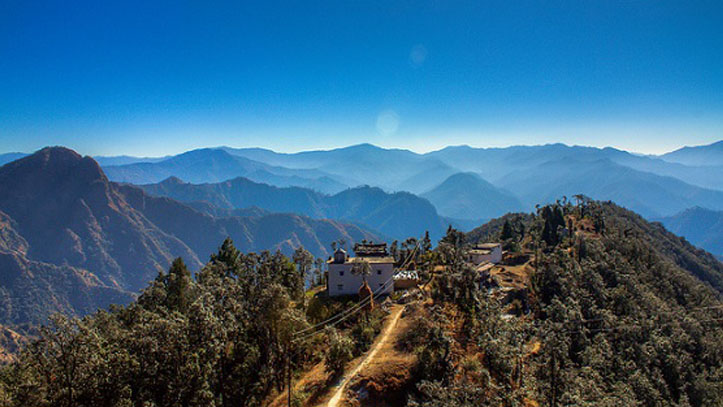
Khirsu sits at roughly 1,700 to 1,760 metres above sea level in the Pauri Garhwal district of Uttarakhand. It is a small village — not a town, not a hill station in the developed sense — surrounded by oak, deodar, and pine forest with apple orchards on the lower slopes and an unobstructed Himalayan ridge visible on clear days.
The peaks you can see from Khirsu on a clear morning: Trishul, Nanda Devi, Panchachuli, Chaukhamba, Bandarpoonch. Not through a break in the cloud cover or from a specific viewpoint at the top of a climb — from the general open spaces around the village, with no particular effort.
From Delhi, it is approximately 365 kilometres by road — around 9 to 10 hours via Meerut, Najibabad, Kotdwar, and Lansdowne. The last stretch from Lansdowne to Khirsu is the part where the views start compensating for the drive time. From Rishikesh, the route goes via Devprayag and Srinagar Garhwal to Pauri — about 155 kilometres, closer to 5 hours on mountain roads.
Kotdwar is the nearest railway station, around 140 kilometres away. From Kotdwar, shared jeeps and local buses run to Pauri. From Pauri to Khirsu, shared transport or a short taxi covers the 15 kilometres.
What Khirsu Actually Is
It helps to set expectations clearly because “hill station” in India suggests something more developed than Khirsu is.
There is no mall road. No tourist market with shawls and Himalayan honey. No line of hotels along a ridgetop. No tonga rides or cable car. The GMVN Tourist Rest House is the most established accommodation option, and the Uttarakhand Forest Development Corporation runs eco-tourism camps here between March and October.
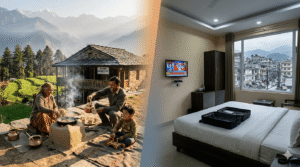
Beyond that, accommodation is homestays — local families who have opened rooms in their homes. The village has a few small dhabas. There is one ancient temple, Ghandiyal Devta, which the local community maintains and which becomes the centre of the village during festivals.
The altitude keeps the temperature reasonable even in May and June, when much of the Garhwal foothills are too hot for comfort. Winters bring cold — temperatures drop to around 0 to 5°C between December and February — and Khirsu gets snow in December and January, which makes it one of the more accessible places from Delhi for a snow experience that doesn’t require navigating the Mussoorie traffic.
The Himalayan View Question
Every piece of content about Khirsu mentions Himalayan views. It is worth being specific about what this actually means here, because there is a difference between a “Himalayan view” in the marketing sense and what you get at Khirsu.
At many hill stations in Uttarakhand, getting a proper Himalayan view requires going to a specific viewpoint, arriving before 8am before haze sets in, and hoping it is not a cloudy week. The view is real, but it requires effort and timing.
At Khirsu, the village itself sits at an elevation and orientation where the high Himalayan range is simply in front of you when you look north. Trishul at 7,120 metres. Nanda Devi at 7,816 metres — the second-highest peak in India. Chaukhamba’s four summits. On a clear post-monsoon or winter morning, these are the backdrop to the village. You don’t go somewhere to see them. You walk out of wherever you’re staying and they’re there.
October and November, after the monsoon clears, give the best visibility. The air is clean from the rains, the sky is often cloudless by 7am, and the peaks catch the first sunlight before anything else. This is when photographers come to Khirsu specifically. There are not many of them. The ones who have been know.
The Forest
Oak forest covers most of the slopes around Khirsu. Not the thin, scrubby cover you get near roads and in the zones where timber cutting has happened — actual dense oak and deodar, with rhododendron on the upper sections, and a forest floor that smells different from most forested places because it rarely gets disturbed.
Walking into this forest from the village takes ten minutes. There are no marked trails in the organised trekking sense. The paths are the ones villagers use — to water sources, to other settlements, through the orchards on the way to wherever they’re going. A host who knows the area can point you to the forest path that circles back to the village in two hours, or the one that climbs toward the ridgeline and takes most of a day.
Bird watching in this forest is underappreciated. The Garhwal hills at this elevation have a range of species that birders specifically seek out — laughing thrushes, flycatchers, barbets, various warblers during migration season. Khirsu is not on the birding circuit the way Pangot near Nainital is, which means the birds haven’t been habituated to large groups of observers. The encounters feel accidental, which is better.
Treks from Khirsu
Tara Kund is the main trek from Khirsu. The lake sits at approximately 2,200 metres — a gain of around 500 metres from the village. It is a day trek, manageable in 4 to 6 hours round trip depending on pace. The trail passes through dense forest and opens to the lake surrounded by Himalayan backdrop. Not heavily trafficked. No permanent tea stalls. Carry water.
Ulkha Garhi (also written Ulka Garhi) is a ruined fort a short distance from Khirsu. The climb is not long — under 2 kilometres — but the elevation gain gives a wider view than you get from the village itself. It is worth the hour it takes.
Doodhatoli is a plateau at around 2,700 metres, accessible from the Pauri Garhwal side. It is a multiple-day trek that requires a local guide — this is not a signposted route. Doodhatoli is where the Alaknanda, Ramganga, and Pindar rivers originate. The plateau has high-altitude grasslands and is one of the less visited trek destinations in the Garhwal region. If you are spending more than three days in Khirsu, asking a host to connect you with a local guide for Doodhatoli is worth it.
Temples and Local Culture
Ghandiyal Devta Temple is the main temple in the Khirsu area. Dedicated to a local regional deity, it sits in the forest above the village. The structure is simple — stone construction, no elaborate embellishment — but the location and the community relationship with it are the point. Festivals here follow the agricultural calendar rather than the national Hindu festival schedule. If your stay coincides with a local festival, you will see the village gather in a way that has nothing to do with tourism.
Jwalpa Devi Temple, dedicated to Goddess Jwalpa, is around 30 kilometres from Khirsu. The drive is worth it on the way in or out rather than as a specific trip. The temple sits in a forested ravine near the Nayar River.
Devalgarh is 15 kilometres from Khirsu — a small town with a cluster of temples including an ancient Rajarajeshwari temple. The town derives its name from the historical Kingdom of Deval, and several carved stone temples from the medieval period survive here in varying states of preservation.
The culture of Pauri Garhwal district is predominantly Garhwali — the people speak Garhwali, follow the agricultural and festival calendar tied to the mountains, and the food at any homestay will be the Pahadi staples: mandua roti, urad dal, aloo ke gutke, seasonal vegetables from the kitchen garden. The apple orchards around Khirsu produce fruit from August through October. If you are here in that window, you will eat apples that were picked that morning.
Staying in Khirsu
The GMVN Tourist Rest House is the most established option with consistent availability. Functional, clean, basic. Good for a base if you want something predictable.
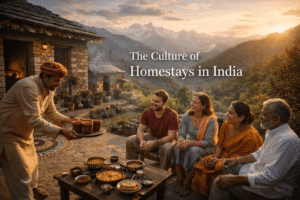
For a different experience, the homestays run by local families are the more interesting choice. Khirsu is small enough that most homestay arrangements happen through local contacts or through platforms like Laluri that list verified Pauri Garhwal properties. Meals are typically home-cooked and included or available at a fixed charge. The host will know the trails, the temple schedule, and what the weather is likely to do.
A few practical notes about staying in Khirsu:
- Mobile connectivity is available but not uniformly strong. Jio has the better coverage in the area. If you are working remotely, check with the specific property before booking.
- There are no ATMs in Khirsu. Withdraw cash in Pauri town before heading up.
- Accommodation options are limited. During long weekends in peak season (April-June, October), book at least two to three weeks ahead. The GMVN fills up first.
- The road from Pauri to Khirsu is paved and manageable in a regular car. The stretch from Lansdowne through Pauri to Khirsu has some hairpin sections but nothing that requires an SUV in good weather.
- Winter driving (December-January) can mean ice on the Pauri to Khirsu stretch. Carry tyre chains if driving your own vehicle.
When to Come
March to June — the most visited window, though “visited” at Khirsu means a few dozen people rather than hundreds. Rhododendrons bloom in March and April. Temperatures are comfortable for walking — 15 to 25°C in the day. Apple orchards are in bloom. Good conditions for Tara Kund and forest walks.
July to mid-September — heavy monsoon. Roads through Pauri Garhwal can get landslides. The forest becomes extremely green and the waterfalls are full, but road risk is real. Avoid if you’re not experienced with monsoon mountain driving.
October and November — the best window for Himalayan views and photography. Post-monsoon clarity, fewer people than summer, mild temperatures. October specifically is when the peaks look sharpest after the rains wash the air. This is when you come if the view is the reason you’re going.
December and January — cold and possible snow. A specific kind of experience — the village quiets down further, the orchards are bare, the peaks are capped with fresh snow. If you want Khirsu as a snow destination close to Delhi, this window works. Check road conditions before starting.
February — still cold but the worst of winter has passed. Rhododendrons start showing colour on the upper slopes. Quiet.
Why Khirsu and Not Mussoorie or Nainital
This is a reasonable question. Mussoorie and Nainital are far more developed, have better transport connections, and have infrastructure for every kind of trip.
The reason to choose Khirsu is precisely because it has none of that.
The Mussoorie mall road in May has traffic jams. Nainital in October has accommodation booked six weeks out and a lakeside that is difficult to enjoy when shared with several thousand other people.
Khirsu in October has nobody. The Himalayan view is comparable or better. The forest is accessible without crowds. The homestay food is genuinely Pahadi, not adapted for tourist preference. The price is lower. The host is present and local in a way that the resort staff in Mussoorie is not.
The trade-off is infrastructure. Khirsu cannot give you a spa, multiple restaurant options, a mall, or a predictable mid-range hotel. If those things matter, go to Mussoorie. It does them well.
If they don’t — if what you’re looking for is a ridge at 1,700 metres where you can hear birds and see Nanda Devi and eat dal that was made in the same kitchen where the family has been making dal for generations — Khirsu is what you’re looking for.
Getting There
By road from Delhi: NH 334 via Meerut → Najibabad → Kotdwar → Lansdowne → Pauri → Khirsu Distance: ~365 km | Time: 9–10 hours
Via Rishikesh: Rishikesh → Devprayag → Srinagar Garhwal → Pauri → Khirsu Distance: ~155 km from Rishikesh | Time: ~5 hours
By train + road: Nearest stations: Kotdwar (~140 km) or Rishikesh (~155 km) Both are well connected to Delhi. From either station: bus or shared taxi to Pauri, then shared jeep or taxi to Khirsu.
Local transport: Shared jeeps run between Pauri and Khirsu regularly during the day. Last vehicle is usually early evening. If arriving late, arrange with your homestay for a pickup from Pauri.
Book a Pauri Garhwal Homestay on Laluri
Laluri lists verified homestays in Pauri Garhwal and across Uttarakhand. Properties are physically checked before listing. Pricing is direct — no commission markup between host and guest.
Browse Pauri Garhwal stays on Laluri →
If you’re planning a Khirsu trip and have specific questions about the area — timing, road conditions, what to bring — the host contact you receive after booking is the best person to ask. They live there.

Leave a Reply