
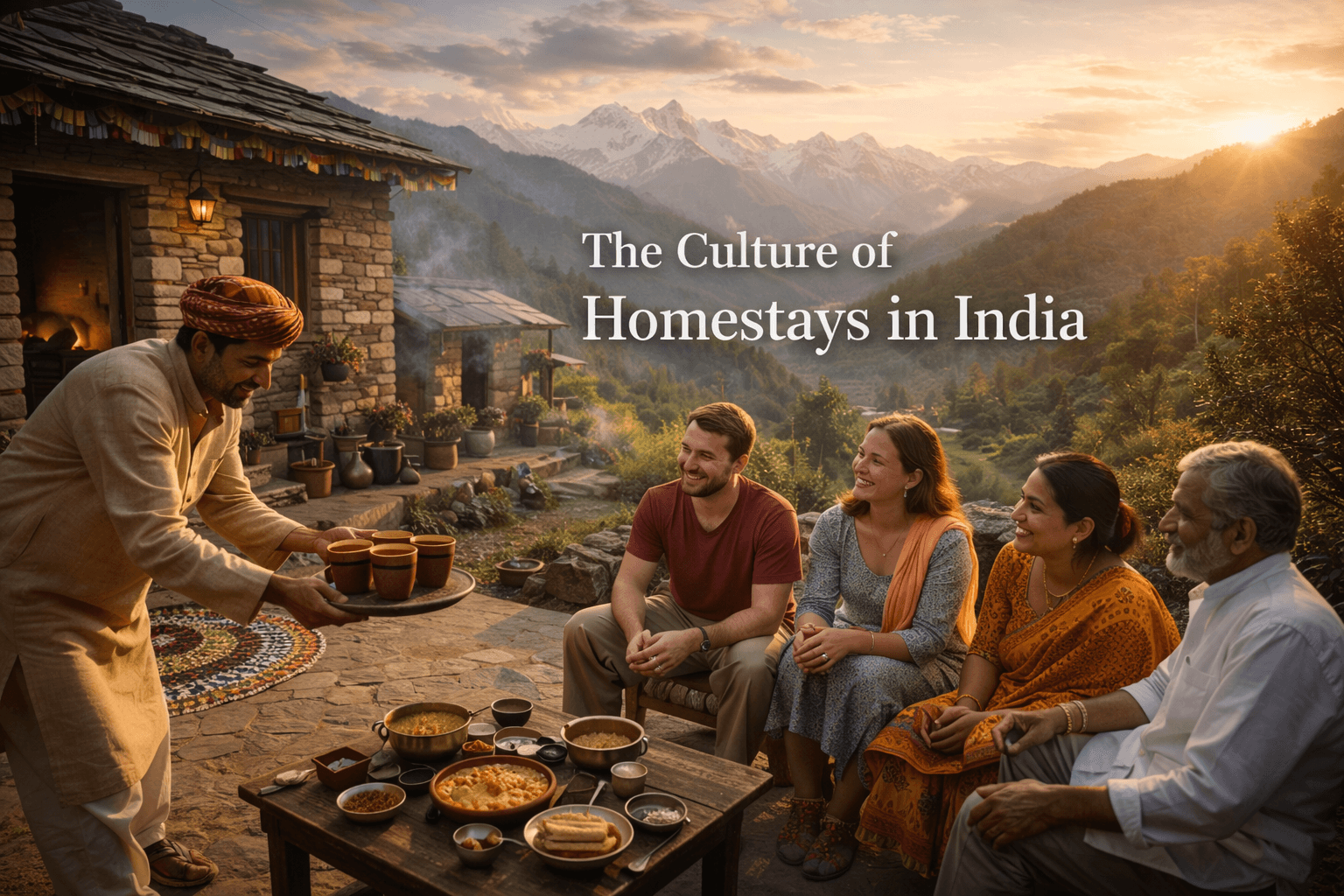

Before there were hotels in India, there were homes.
Travellers crossing the subcontinent — pilgrims, traders, wandering scholars, royal messengers — didn’t sleep in purpose-built lodgings. They slept in houses. Whoever owned the house along the route opened it. Fed the traveller. Let them sleep, asked where they were going, sometimes pointed them in the right direction come morning.
This wasn’t hospitality as a service. It was hospitality as a social obligation — the principle that a guest who arrives at your door is, for the duration of their stay, your responsibility.
The Sanskrit phrase that captures it is Atithi Devo Bhava: the guest is god. It appears in the Taittiriya Upanishad, written somewhere around 600 BCE. The instruction wasn’t aspirational — it described an actual practice. Across the Hindu, Buddhist, Jain, and later Sikh and Islamic traditions of the subcontinent, the guest was to be received without question, fed without condition, and seen off with whatever could be spared for the journey.
The homestay, in 2026, is that practice — formalised slightly, adapted for a world of WhatsApp bookings and Google reviews, but structurally unchanged.
The Ancient Roots: Dharamshala, Sarais, and the Host’s Duty
Long before the word “homestay” entered any travel vocabulary, India had an infrastructure of hospitality built into its architecture.
Dharamshalas — rest houses attached to temples and managed by religious trusts — stretched along every major pilgrimage route. Char Dham pilgrims passed through them. Traders on the silk and spice routes used them. The dharamshala was not a commercial enterprise; it was a duty. Communities maintained them collectively because the traveller passing through was understood to be doing something that mattered.
Sarais — roadside rest stops with accommodation for travellers and their animals — were formalised under the Mughal administration in the 16th century. Sher Shah Suri, who built the Grand Trunk Road stretching from Bengal to Kabul, established sarais roughly every 8 kilometres along it. At peak, there were more than 1,700 sarais on that single route. Each sarai had water, basic food, and shelter — maintained by the state specifically because a traveller in motion was considered under the state’s protection.
In village India, none of this formalisation was necessary. The obligation was simply understood. A stranger at the door got food. If it was late, they got a place to sleep. The host’s own meal could wait.
This ethic was not unique to any one region or religion. Kashmiri households fed travellers coming over mountain passes. Rajput families housed traders moving between the Thar Desert trading towns. In the northeast, tribal communities along migration routes absorbed wanderers into the household for the duration of their need. The specifics varied; the principle did not.
Colonial Disruption: When Hospitality Became Commerce
The British arrival changed the physics of Indian hospitality in ways that are still working themselves out.
The colonial administration needed accommodation infrastructure that was controllable, sanitary by its own standards, and separate from the local population. The result was the dak bungalow system — government rest houses built along administrative routes, maintained by a chowkidar, accessible to British officers and, later, to some Indians of sufficient standing.
Alongside this came the Western hotel model: commercial accommodation as a transaction. Pay for the room, get the room. No obligation beyond that. The guest is a customer, not an atithi.
This model took hold fastest in cities and along the railway network. By 1900, Bombay, Calcutta, and Madras had European-style hotels. By independence in 1947, a tier of “hill station” hotels had grown up around the British summer capitals — Shimla, Mussoorie, Ooty, Darjeeling — catering primarily to the administrative class and, later, the tourist.
In village India, none of this happened. The dak bungalow and the European hotel were urban and infrastructural realities. In Garhwal villages, in Kumaoni hamlets, in the tribal settlements of central India and the northeast, a traveller who arrived still arrived at a door. The response was still the door opening.
The Modern Homestay Movement: How It Formalised
The contemporary homestay as a recognised accommodation category in India has a patchy, difficult-to-pin origin. It emerged in different places for different reasons at roughly the same time.
Kerala is usually credited with the first formalised homestay model in India. The state’s tourism department began promoting home-based accommodation in the 1990s, initially targeting the backwaters and spice-estate circuits of Alappuzha, Thekkady, and Wayanad. Families in plantation regions — Syrian Christian households with large colonial-era bungalows, Nair taravad homes, coffee and cardamom growers with spare rooms — started registering as homestays. By the early 2000s, Kerala’s homestay sector was large enough to function as a distinct category in tourism statistics.
Rajasthan followed a different route. The state’s abundant havelis — courtyard mansions of merchant and noble families — were increasingly expensive to maintain and increasingly empty as joint families dispersed. Opening them to guests was partly economic necessity, partly a recognition that the architecture itself was the product. The Rajasthan government’s paying guest scheme formalised this in the 1990s. Some of the most recognisable heritage homestays in India — ancestral haveli stays near Jaisalmer, small fort properties in the Aravalli hills, royal-family homes in Shekhawati — came out of this period.
Himalayan homestays developed more slowly and more organically. In Himachal Pradesh, families in apple-growing valleys near Manali and Kullu had been taking in trekking parties informally for decades — charging for meals and floor space, no registration, no receipt. This quietly professionalised through the 1990s and 2000s as trekking tourism grew. In Uttarakhand, the same pattern played out after the state was carved from Uttar Pradesh in 2000. Village families near pilgrimage routes — the Char Dham corridor, the Panch Kedar circuit — started opening rooms. The Uttarakhand government’s Pandit Deendayal Upadhyaya Homestay Scheme eventually gave this a formal structure: registration, subsidy for room construction, listing on state tourism portals.
Regional Homestay Cultures Across India
India’s homestay cultures are as varied as its geography, food, and languages. Each region brings a distinct character to the idea of hosting.
Uttarakhand and the Garhwali-Kumaoni Tradition
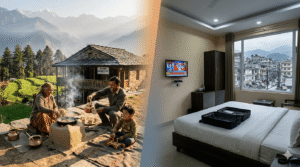
In the Garhwal and Kumaon hills of Uttarakhand, the homestay sits inside a culture of atithi satkaar — guest honouring — that hasn’t changed much in centuries. The Garhwali household receives a guest as a temporary member of the family. You eat what the family eats. You sit where the family sits. The distinction between guest space and family space is not sharp.
Food is the most visible expression of this. Mandua roti, urad dal, seasonal kafali, jhangora — the crops that grow in the hills — are what appear on the table because that is what the kitchen produces. There is no special guest menu. The gesture is: this is what we have, and it is yours.
Pahadi families who run homestays in Tehri Garhwal, Pauri, Chamoli, and Kumaon’s Pithoragarh and Almora districts have not significantly changed this character in transitioning from informal hosting to registered accommodation. The informality is structural, not accidental.
Kerala’s Syrian Christian and Nair Heritage Stays
Kerala’s homestay culture is inseparable from its domestic architectural tradition. The nalukettu — a traditional four-sided courtyard home — and the tharavad — the ancestral joint-family mansion of Nair aristocracy — were designed for joint families of twenty to thirty members. As families dispersed through the 20th century, these structures emptied. The homestay model gave them a reason to be maintained.
Philipkutty’s Farm in Kumarakom is one of the best-known examples: a private farm island in the backwaters, a Syrian Christian family, several decades of guests becoming regulars, and a kitchen that serves fish curry and appam in the way that has always been served in that house. The food is not adapted for tourism. The tourism adapted to the food.
Rajasthan’s Haveli and Royal Family Stays
In Rajasthan, the host is often the descendant of a thakur, a merchant, or in some cases an actual royal family. The haveli — built for multiple generations of a joint family plus their guests, their storerooms, their temple, their animals — is a hospitality machine in architectural form. It was designed to house guests. Opening it to paying travellers is, in some sense, returning it to its original purpose.
What makes Rajasthani heritage homestays distinctive is the weight of history they carry. A room in a 19th-century haveli in Shekhawati has fresco paintings on the walls — painted when the merchant family commissioned them to display their prosperity and their gods. Sleeping in that room is a specific thing. It is not the same as sleeping in a room that has been designed to look historic.
Northeast India: Tribal Homestays and the Nagaland Model
The tribal communities of Nagaland, Meghalaya, Arunachal Pradesh, and Sikkim have some of the most intact community-hosting traditions in India. The Naga practice of hospitality — especially around the Hornbill Festival — is not tourism infrastructure; it is a continuation of how communities have received outsiders for as long as anyone can document.
Demul village in Spiti Valley runs a formally socialist homestay model: all 24 participating households are assigned guests by rotation, ensuring every family earns equally. No individual family can market themselves above the collective. Visitors are assigned a household by the village coordinator. The system is the opposite of the market-based hospitality model — and it produces one of the most genuine communal experiences available anywhere in Indian travel.
The Kandara village homestay in Rudraprayag, Uttarakhand, operates on a similar community-rotation principle — relevant to Laluri’s region and worth knowing about.
Kerala Backwaters, Coffee Estates, Plantation Stays
South India’s plantation homestay culture is a different thing from the village stay. A Coorg homestay in a 1908 coffee estate bungalow — stone floors, wooden beams, the smell of coffee at 6am, estates stretching in every direction — is a specific experience that grew out of estate owners having more space than they needed and travellers wanting something that wasn’t Bangalore.
Woodway in Chikmagalur, one of the region’s first plantation homestays (opened 2001), has never advertised itself as a hotel. The owner’s principle — “the moment a home calls itself a hotel, warmth changes” — is a more precise statement of what makes a homestay work than most formal hospitality training produces.
Heritage Homestays: Living Architecture
One distinct category within India’s homestay culture deserves its own treatment: homes where the building itself is the experience.
These are properties that are not just old but architecturally significant — and where the alternative to homestay use is abandonment or demolition.
Peepal Haveli in Nawanpind Sardaran, Punjab — a 150-year-old traditional Punjabi kothi, revived by conservation architect Gurmeet Sangha Rai as a boutique homestay. The architecture would be impossible to replicate. It exists because one family chose to restore rather than abandon.
The Judge’s Court in Pragpur, Himachal Pradesh — a 300-year-old heritage country manor in India’s first declared heritage village. Guests sleep in rooms that have been continuously occupied for three centuries.
Chettinadu Mansion in Karaikudi, Tamil Nadu — a grand Chettiar home, 100 years old, built when Nattukotai Chettiars controlled trade across Southeast Asia and brought back teak from Burma, tiles from Italy, chandeliers from Belgium. The architecture of wealth, maintained now as a living homestay.
Ahilya Fort in Maheshwar, Madhya Pradesh — run by descendants of Maharani Ahilyabai Holkar, the 18th-century ruler who is credited with rebuilding temples across India. Guests stay inside a working royal household with direct family continuity to one of India’s most significant historical figures.
What these properties share: they cannot be replicated. The experience is inseparable from the building’s actual age and the family’s actual history. A resort can build a “heritage aesthetic.” It cannot build a 300-year-old judge’s court.
Government and Policy: The Formal Framework
India’s homestay sector is now large enough to be a serious policy subject.
The Tribal Homestay Program 2026, implemented by the Ministry of Tourism alongside Swadesh Darshan 2.0 and PM Janjatiya Unnat Gram Abhiyan, is developing 1,000 homestays across tribal areas in states including Madhya Pradesh, Odisha, Andhra Pradesh, and Tamil Nadu. Financial assistance runs to ₹5 lakh for new construction and ₹3 lakh for renovation. The stated goals are economic (supplementary income for tribal families) and cultural (preservation of traditions through the incentive of sharing them with visitors).
Uttarakhand’s Pandit Deendayal Upadhyaya Homestay Scheme provides state registration, subsidy, and listing support to qualifying homestay operators. The registration criteria — owner must live on the property, maximum six rooms, basic safety and sanitation standards — are exactly the criteria that distinguish a real homestay from a commercial guesthouse using the word.
Rajasthan’s Paying Guest Scheme, one of the oldest formal frameworks in India, has been running variants since the 1990s and currently covers hundreds of properties across the state.
These frameworks matter because they create the difference between informal hosting — which has always existed and always will — and a scalable rural tourism economy that keeps income inside communities.
Why Homestays Matter for Cultural Preservation
This is the argument that gets made most often and least convincingly in travel writing, because it usually comes out as vague uplift language. Here is the specific mechanism:
When a Pahadi family in Uttarakhand earns sufficient income from hosting guests, the calculus on staying in the village versus migrating to Haridwar or Dehradun changes. Migration — primarily young men leaving for construction or service work in plains cities — is the main driver of village depopulation in Uttarakhand. Villages that lose their working-age population lose their festivals, their farming knowledge, their oral histories, their languages. Within a generation, they lose the culture entirely.
A homestay that earns ₹1.5 lakh in a season is not charity. It is an economic argument for staying. The cultural preservation is a consequence of that economic argument, not a separate project.
The same mechanism operates in tribal areas, in Rajasthani villages where the haveli was about to be sold for material, in Kerala plantation estates where the family could not afford the maintenance. The homestay makes the building worth keeping. The building being kept means the culture that created it has somewhere to live.
What Travellers Are Actually Looking For
The shift toward homestays in India is not only a supply-side story (families opening their homes). It is a demand-side shift that accelerated after 2020.
The travellers coming to Uttarakhand in 2026 are not primarily first-timers to India. Many have already done the hill station hotel circuit — Mussoorie, Nainital, a resort in Rishikesh. They are looking for the next layer. Something that feels like the place rather than a version of the place cleaned up for visitors.
They want to know what kafali tastes like when it is cooked in the house where the woman who makes it learned to make it from her mother. They want to hear the village in the morning. They want the host to tell them which trail the leopard uses, not because it is exotic, but because it is real information about where they actually are.
This is what India’s homestay culture, at its best, provides. Not an experience designed to feel authentic. The actual thing.
Laluri’s Place in This Tradition
Laluri is a booking platform for Uttarakhand homestays — Tehri Garhwal, Pauri Garhwal, Chamoli, Rudraprayag, and the Kumaon districts. It exists because the families running the best Pahadi homestays in these areas needed a direct booking channel that didn’t take a percentage of their income and didn’t require them to navigate the listing requirements of platforms built for a different kind of accommodation.
The tradition being described in this article — Atithi Devo Bhava, the sarai network, the Garhwali household that opens its door — is the tradition Laluri’s host families are continuing. The platform is just the mechanism for making it findable.
Every property on Laluri has been physically visited. Every host listed is the actual host. The price shown is the price paid.
If you want to stay inside this tradition rather than looking at it from a resort terrace, the listings are at laluri.com/homestays.
 chevron_right

Leave a Reply