
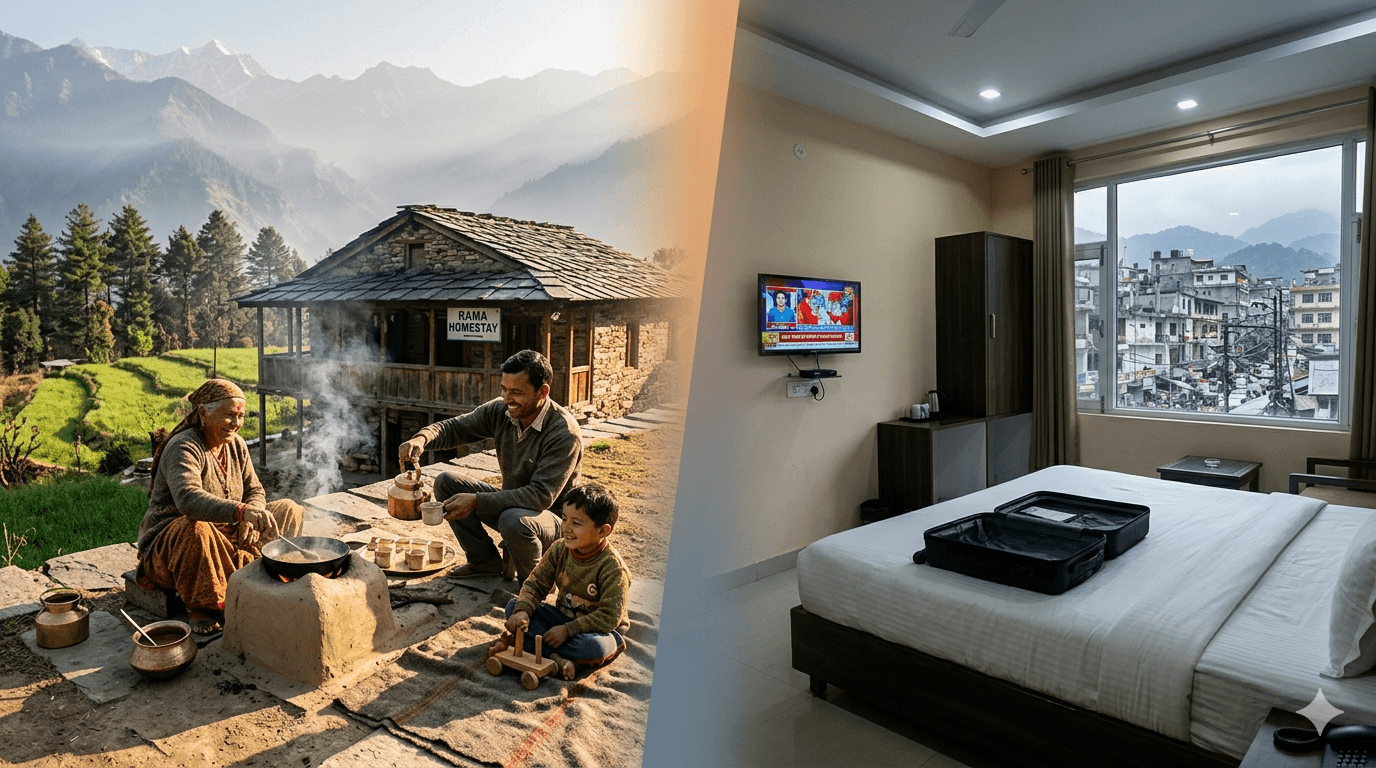

Before you book your next trip to the Uttarakhand hills, there’s a choice most travel guides gloss over: homestay or resort?
Not because they’re afraid to answer it. Because the honest answer depends on what you’re actually looking for — and most travel content doesn’t want to risk telling someone they chose wrong.
This article will. Both options have real advantages. One of them is better for most people going to the Uttarakhand hills right now. Here’s the full comparison.
The Basic Difference
A resort in Uttarakhand is a commercial property built to accommodate multiple guests simultaneously. It has staff, a managed kitchen, a reception, branded amenities, and a hospitality model where consistency is the goal.
A homestay is a private family home where one or two guest rooms have been opened to outside visitors. The host lives there. The kitchen is the family kitchen. There is no “managed experience” — just a household that has made room for you.
Everything else in this comparison flows from that structural difference.
Price: What ₹2,000 Buys You in Each Category
This is the comparison most people want first, so here it is plainly.
At a resort for ₹2,000–₹3,500 per night, you’re typically getting:
- A standard room with attached bathroom
- Breakfast (usually a fixed menu — toast, eggs, tea, sometimes a token paranthas option)
- Access to common areas — a lawn, maybe a bonfire space
- A restaurant or kitchen that serves meals at extra cost
- Wi-Fi that is described as “complimentary” and works variably
At this price bracket in popular Uttarakhand destinations — Mussoorie, Lansdowne, Nainital outskirts — you’re getting a room in a building that is managing 20 to 40 guests at any time. The staff changes shifts. The food comes from a commercial kitchen designed for volume. Your check-in involves a form.
At a homestay for ₹1,200–₹2,500 per night, you’re typically getting:
- A private room, often with mountain or garden view
- Home-cooked meals — not a fixed menu but whatever the family cooks that day
- A host who is present, knows the area, and will actually talk to you
- Often more space — a terrace, a balcony, a common room that the family uses
- Quiet that isn’t manufactured
The price overlap is real. A good Pahadi homestay in Kanatal or Chamba costs ₹1,299–₹2,000 per night. A mid-range resort in the same region starts at ₹3,000 and climbs fast. For the same or less money, the homestay often delivers a better room and categorically better food.
Where resorts justify higher prices: properties with genuine infrastructure — swimming pools, large conference facilities, spa services, multiple dining options. If those things matter to you, the resort price is what it is.
Food: The Biggest Practical Difference
This is the one that surprises people most.
Resort food in the Uttarakhand hills is almost universally worse than homestay food. That’s not an opinion — it’s a structural reality.
A resort kitchen feeds 30 to 60 people per meal. It needs to be fast, consistent, and safe at scale. The result is food that is technically fine and genuinely unmemorable. Paneer butter masala that tastes like paneer butter masala in Gurugram. Aloo paranthas made from a prep schedule. Dal that has been sitting warm for two hours.
A homestay kitchen cooks for four to eight people at most. The host knows by dinner time what everyone’s eating. The sabzi was bought that morning from wherever the host buys vegetables. In most Garhwali homes, that means seasonal produce from the kitchen garden or the local village market — not a wholesale supplier’s weekly delivery.
The food at a good Pahadi homestay is the kind of food that makes people write reviews that say things like “I’ve never had dal like this.” Mandua roti with ghee made that morning. Kafali cooked with local leafy greens. Jhangora kheer in season. Aloo ke gutke with jakhiya tempering. None of these appear on a resort menu, and even if they did, they’d be a version of themselves — cleaned up and regularised for broader palatability.
If food matters to you on a trip to Uttarakhand, and you want to eat the way the hills actually eat, the homestay wins this category without contest.
Privacy and Space
Here is where the resort has a genuine advantage — and most people don’t realise it until they arrive at a homestay and find it’s not the problem they thought it would be.
At a resort, your room is your room. You don’t share space with the property owner. You don’t run into the family in the corridor. If you want to stay in your room all day and order room service, nobody notices.
At a homestay, you’re in someone’s house. The host family is there. You might hear them in the kitchen in the morning. The dogs are their dogs. The small child in the courtyard belongs to someone in the household. If you’re the kind of traveller who values complete anonymity and separation, this is a real consideration.
That said — most people who stay at Pahadi homestays find the opposite of what they expected. The host’s presence is not intrusive; it’s orienting. Knowing someone in the building is watching out for you, knows when you left and when you’re expected back, will notice if something seems wrong — that feels like safety to most guests, not surveillance.
The privacy question at a homestay is less about the host and more about other guests. A two-room homestay with another couple staying at the same time means you’re sharing a terrace, possibly a bathroom, and definitely a breakfast table. This is either charming or slightly awkward depending on your temperament. At a resort, the other guests are strangers passing through a lobby.
Location: Where Each Type of Property Sits
This is one of the clearest differences and one of the least discussed.
Resorts in Uttarakhand are, almost without exception, built on land that was either cheap, accessible, or already zoned for commercial development. That means highway-adjacent, edge-of-town, or in established tourist zones like the Mussoorie-Dehradun corridor, Nainital, and Rishikesh.
The view from a resort terrace in Uttarakhand is often of other resorts.
Pahadi homestays sit where the family lives — which is in villages, on hillsides, along routes that don’t have enough traffic to support commercial development. This means homestays are genuinely inside the landscape that people come to Uttarakhand to see.
A homestay in Kanatal is in a village surrounded by oak and rhododendron. A homestay in Mandlu Village in Pauri Garhwal is 1.5 km from any motor road, in a ridge position with Himalayan views. A homestay in Munsiyari faces Panchachuli. The location advantage of a homestay in Uttarakhand isn’t marketing — it’s simply where the families live.
The Quiet Question
Most people who say they want to “escape to the mountains” are actually trying to escape noise. The specific noise of cities: traffic, construction, notifications, the background hum of being around too many people doing too many things.
Resorts in Uttarakhand understand this market and build around it. Infinity pools facing ridgelines. “Forest retreat” branding. Spa menus. Instagram-ready common areas. But a resort by definition has generators, staff accommodation, service vehicles, kitchen exhaust systems, other guests in rooms above and beside you, and a check-in area near a road. The quiet is curated to the extent possible, but the infrastructure required to run a 20-room property creates its own ambient noise floor.
A Pahadi homestay in a village above the highway has quiet that doesn’t need curation. The village is quiet because nobody built anything there that requires volume. Birdsong in the morning at a Garhwal homestay is not a sound design decision — it’s just what happens when there’s nothing louder.
For people coming to Uttarakhand specifically because they want to stop hearing things, a homestay is the better bet.
Service: What You Can Expect from Each
Resorts have trained staff. They follow protocols. Check-in is smooth. Complaints go through a process. Housekeeping happens on a schedule. If something goes wrong with the room, there is a mechanism.
This is a genuine advantage. Especially for travellers who are particular about service consistency, or who have had bad experiences with unstructured accommodation.
Homestay service is different in character. The host is not trained in hospitality. They’re a person who has opened their home. This means:
- Problems get solved personally, not through a ticket system. If the geyser isn’t working, the host fixes it or finds someone who can, because it’s their house.
- Requests are accommodated or explained honestly. If you ask for a meal option the kitchen can’t do, you’ll be told directly — not given a watered-down version of what you asked for.
- The relationship is a real one. By the second day, most guests at a Pahadi homestay are on first-name terms with the host. The host knows when you prefer breakfast. They know if you’re planning to hike because you mentioned it at dinner.
Whether this model is better than trained resort service depends entirely on what you’re looking for. For people who want to be managed comfortably, the resort wins. For people who want to be accommodated humanly, the homestay does.
WiFi and Work: The Workation Question
Both types of properties advertise WiFi. The reality differs.
Resorts in established Uttarakhand tourism zones generally have better infrastructure. The bandwidth has to support many simultaneous users, so the router setup is more serious. In Mussoorie, Nainital, and the Rishikesh area, resort WiFi is usually reliable enough for video calls.
Pahadi homestays have variable connectivity. In Tehri Garhwal’s Kanatal and Chamba belt — now well-connected with 4G — most homestays with WiFi have adequate bandwidth for regular work. In more remote locations — Urgam Valley in Chamoli, Mandlu Village in Pauri, Harsil in Uttarkashi — the host might have a JioFi or a local broadband connection that works on a good weather day and doesn’t in a cloudy one.
The honest test: if you’re doing a workation, ask the specific host for the network name, whether it supports video calls, and what the backup is. A good host will tell you honestly. A host who says “yes WiFi is available” without more detail is either not sure or optimistic.
For workations in Uttarakhand, homestays in the Kanatal-Chamba-Tehri corridor are the better bet because 4G is consistent and many hosts have upgraded their connections in the last two years specifically to attract remote workers.
Children and Families
Resorts are designed for families with children. They have structured things for children to do. Lawns, sometimes play areas, fixed meal times that work with nap schedules.
But many parents who’ve done both say the homestay experience with children is qualitatively different in ways that are hard to articulate but obvious in retrospect.
At a resort, children are managed. At a Pahadi homestay, they’re in a house. They follow the host’s animals around. They watch vegetables being prepared. They eat food that tasted like something because it was grown nearby. They ask the host questions and get answers that aren’t scripted.
One family who stayed at a Kanatal homestay described their eight-year-old asking the host why the cow was tied to that particular tree every morning. The host explained the rotation of grazing patches, the winter fodder planning, the difference between seasons. The child went home and kept asking questions about farming for weeks.
No resort facilitates that conversation. Not because they’re bad at their job, but because that’s not their job.
Groups and Large Bookings
Here the resort has a clear, simple advantage.
A Pahadi homestay has one to four rooms. A group of ten cannot stay together at one homestay. A family reunion, a corporate offsite, a friend group of eight — these require resort infrastructure.
If you’re travelling as a group larger than four to six people and want to be in the same property, a resort is the practical answer in Uttarakhand. There is no reasonable version of a large-group stay in a genuine family homestay.
What Each Type Actually Gets Right
Resorts get right:
- Consistent service at scale
- Facilities (pools, spas, event spaces)
- Group accommodation
- Trained staff for specific needs
- Predictability — you know what you’re getting
Homestays get right:
- Food quality and authenticity
- Location inside the landscape
- Real quiet
- The host relationship and local knowledge it brings
- Price for what you actually receive
- The fact that your money goes to a family rather than a property management company
The Honest Recommendation
For a couple or solo traveller coming to Uttarakhand for 3 to 7 nights, wanting to experience what the hills actually are rather than a hospitality version of them — a Pahadi homestay is the better choice at almost every price point.
For a group of 8 or more, or anyone who needs consistent service infrastructure, or anyone who knows they want a spa and a pool — a resort is the correct answer.
For families with children old enough to be curious about the world outside a resort lawn — a homestay is worth trying at least once. Most families who do it once don’t go back to resorts for Uttarakhand trips.
The comparison isn’t about which option is objectively better. It’s about which one matches what you’re actually going to Uttarakhand for.
If you’re going to check off a hill station trip, a resort does that fine.
If you’re going to actually be in the hills, a homestay does that better.
Book a Pahadi Homestay on Laluri
Laluri lists verified homestays across Uttarakhand — Tehri Garhwal, Pauri Garhwal, Chamoli, Rudraprayag, and Kumaon. Every property has been physically checked. Pricing is direct — no commission, no service fee added at checkout.
If you’re planning a trip and want to compare options, the listings include honest descriptions of what each property does and doesn’t offer.

 chevron_right


Leave a Reply